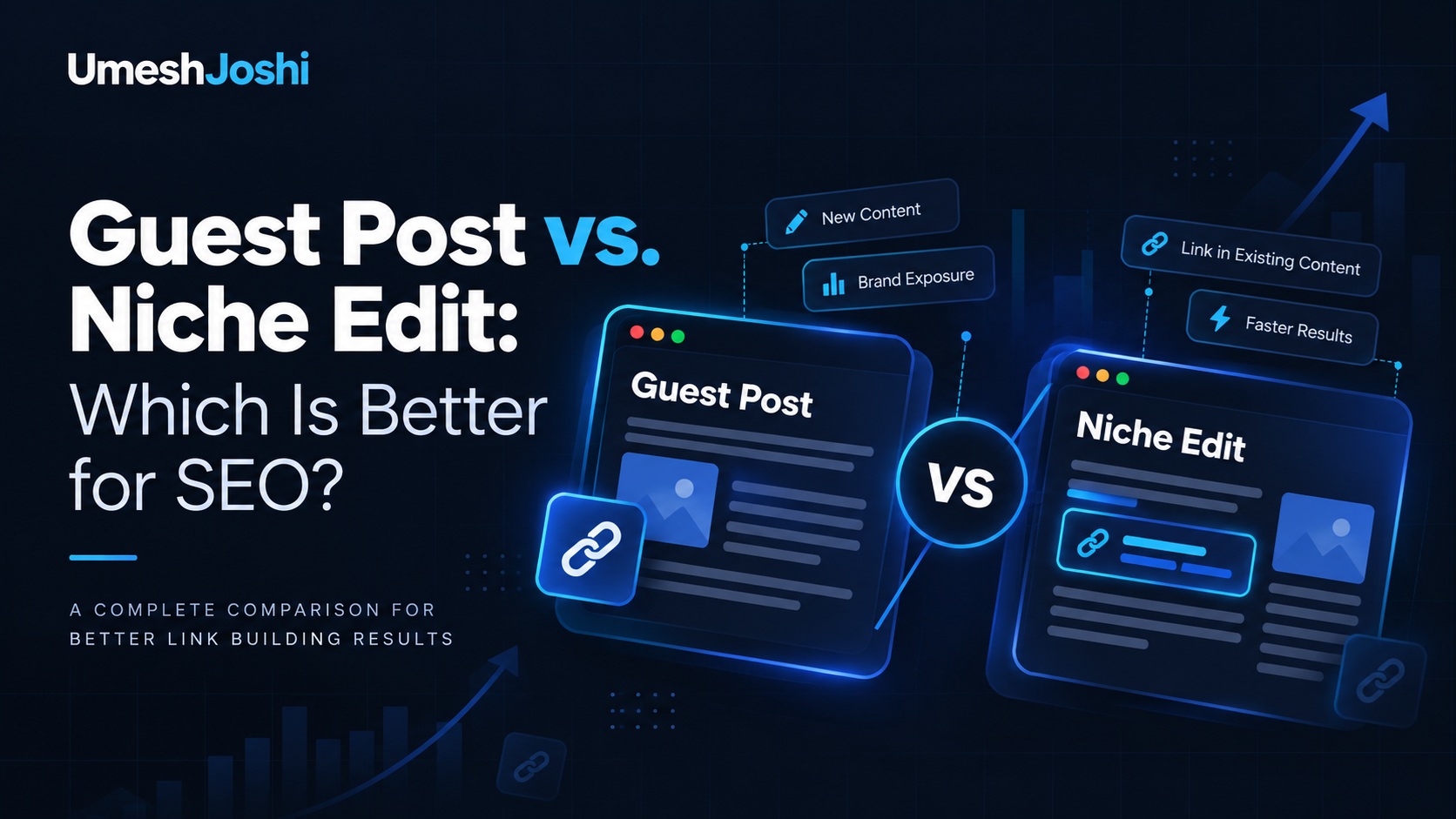
Guest post or niche edit? Well, neither one wins every time. Client after client asks me about guest posts vs. niche edits, and my honest answer is that it depends on your site, your budget, and your timeline. A guest post gives you a fresh article built around your topic. A niche edit puts your link inside an existing article that's already indexed and often already ranking. Both can work well, and both can backfire if you pick the wrong sites. In this blog post, we’ve covered how each method works, what they cost, and when I'd use each one. Read on to know.
How a Guest Post Works?
A guest post is new content you write and publish on someone else's website. Your link sits inside that article.
Here's the usual flow in my campaigns:
-
Find relevant sites that have real traffic in your niche.
-
Pitch topic ideas to the editor.
-
Write the article to the site's guidelines.
-
Get publisher approval, which often comes with edits.
-
Go live, and then I check that the page gets indexed.
The big plus is control. You shape the topic, the angle, and the editorial context around your link. You also get in front of a new audience, which can bring referral traffic and brand recognition, not just a backlink.
The downside is time. Writing, review, and publishing queues can stretch a placement from a few days to several weeks.
How a Niche Edit Works
A niche edit, also called a link insertion, adds your link to an existing article on another site. Nothing new gets published. The site owner updates a relevant sentence, or adds a line, so your page fits naturally.
In link insertion SEO, the appeal is simple. The page already has link age, it's already indexed, and it may already have traffic and backlinks of its own. Your link benefits from that history from day one.
The catch is that you don't control the page. The topic, the surrounding text, and future edits all belong to the publisher. If the page gets deleted or rewritten, your link can disappear with it.
People often ask about the difference between niche edit and link insertion. In practice, there isn't one. They're two names for the same thing, and "niche edit" is simply the term link builders started using.
Guest Post vs. Niche Edit: What's the Difference?
Here's a side-by-side view of niche edits vs. guest posts:

Both methods produce contextual backlinks, meaning links placed inside the body of relevant content rather than in footers or sidebars. That shared trait matters more than the method. Some people call niche edits curated links, because you're choosing a specific page instead of creating one.
Guest Post vs. Niche Edit: Which Is Better for SEO?
Search engines don't reward a format. They respond to relevance, quality, and natural patterns. When I compare guest posting vs. niche edits for a client, these are the questions I actually ask.
Is link insertion safer than guest posting? Not by default. Safety comes down to the site and the behavior, not the label. Google's spam policies call out buying links for rankings and guest posts with optimized anchor text as link spam. Paid placements are fine in Google's eyes when they carry rel="sponsored" or rel="nofollow". Either method can be risky if it's done carelessly.
The main link insertion risks I watch for:
-
Sites that openly sell links on every page
-
Old articles stuffed with dozens of outbound links
-
Topics that have nothing to do with your page
-
Exact-match anchor text used over and over
For guest posts, the warning signs are thin "write for us" sites with no real readers and content that exists only to hold a link.
Are link insertions worth it? They can be, especially when the page is relevant and still pulls organic traffic. Link insertion on old articles works best when the content is still accurate and getting visits. A dusty 2017 post with zero traffic rarely helps much.
What About Cost?
Link insertion cost is often lower than guest posting because nobody has to write a new article. That said, an insertion on a high-authority page that already ranks can cost more than a mid-tier guest post.
On guest post vs. link insertion cost, the main drivers are:
-
Site authority and real organic traffic
-
How competitive the niche is
-
Content writing (guest posts only)
-
How much outreach and negotiation it takes
I quote per placement or as a monthly retainer, because prices vary so much by niche and metrics. I don't believe in one-size price lists.
Guest Post vs. Niche Edit: Which Should You Choose?
Here's the decision guide I use with clients.
Choose guest posts if:
-
You have a new website and need to build topical authority from scratch
-
You want brand exposure and referral traffic, not just a link
-
You want full control over the content and anchor text
-
Your timeline is flexible
Choose niche edits if:
-
You have an established site and want faster movement on specific pages
-
Your budget is tighter and there's no content budget
-
You've found relevant articles that already rank for your topic
-
You want links that come with existing page authority
Guest post or link insertion for a new website? I usually lead with guest posts, then add a few niche edits once the site has some footing. A brand-new domain with only insertions can look odd in a link profile. [Umesh to confirm this is his usual approach]
How to Build a Sustainable Link-Building Strategy
The strongest profiles I've built mix both methods with digital PR and resource page links. A few habits keep a campaign healthy:
-
Vet every site manually. Check real traffic, topical relevance, and how many outbound links it carries.
-
Vary your anchor text. Use branded, natural, and partial-match anchors. Keep exact-match rare.
-
Pace your links. Steady growth looks natural. Sudden spikes don't.
-
Track every placement. I log the URL, DR, traffic, and anchor in a live sheet for each client.
-
Prioritize content relevance over metrics. A relevant DR 35 site often beats an off-topic DR 70.
Expect patience. In my experience, new links usually take about 3–8 weeks to show up in rankings once they're crawled and indexed.
Bottom Line
The guest post vs. niche edits debate doesn't have one winner. Guest posts give you control and new audiences. Niche edits give you speed and existing page strength. Pick based on where your site is today, and judge every link by relevance and quality, never by format alone. If you'd like help working out the right mix for your site, my link building team and I can audit your profile and map out a plan. Contact us now for more information.
FAQs
What is a link insertion in SEO?
It's when your link is added to an article that's already live on another site. Since the page is indexed and has history, the link can help sooner than one on a new page.
Is guest posting better than link insertion?
Not always. Guest posting gives you more control and a new audience, while link insertions are often faster and cheaper. It depends on your site's age, budget, and goals.
Are niche edits safe?
They're as safe as the sites you use. Relevant pages and natural anchors keep risk low, while link farms and off-topic pages raise it.
What is the difference between a guest post and a niche edit?
A guest post is a new article with your link in it. A niche edit adds your link to an existing article, which brings its age and traffic with it.
Does guest posting still work?
Yes, on relevant sites with real readers and useful content. What stopped working is mass posting on low-quality sites with keyword-stuffed anchors.